Friday, December 28, 2007

Change the Way You Think About Food


Here’s how to overcome temptation and guilt and forge a healthier relationship with food.

“Sarah” (not her real name) remembers one particularly argumentative telephone call from her ex-husband a few years ago, a call that really set her off. “I felt so uncomfortable and inadequate,” the 57-year-old Vermont-based social worker remembers, “the thought of candy just popped into my mind, and I couldn’t get rid of it. It was almost as if I was having two conversations. One was with him, fighting, and the other was with myself, saying, ‘When can I go out and get that candy?’” Long after she’d hung up, the visions of sweet treats remained, tempting and specific: “It was Pepsi, and three different types of candy,” she recalls distinctly. “Pull-apart Twizzlers, Skor bars and Butterfinger bars.” Though it was the middle of a workday, Sarah couldn’t concentrate on her work or think of anything else until she went out and bought the candy and soda. “I ate them all in my car, really fast,” she remembers. “And then, like always, I felt terrible about myself for being so weak.”

Continue article here.

Thursday, December 27, 2007

All honor to a brave, strong and courageous woman


(CNN) -- Benazir Bhutto, who was assassinated Thursday in Rawalpindi, was the first female prime minister of Pakistan and of any Islamic nation. She led Pakistan from 1988 to 1990 and again from 1993 to 1996.

Benazir Bhutto died Thursday after a suicide bombing at a political rally in Rawalpindi, Pakistan.

Bhutto, 54, spent eight years in self-imposed exile in Great Britain and Dubai after President Farooq Leghari dismissed her second administration amid accusations of corruption, intimidation of the judiciary, a breakdown of law and order, and undermining the justice system.

She was found guilty of corruption and sentenced to five years in prison. The conviction was later overturned but she remained in exile until this year.

She returned to Pakistan in October after President Pervez Musharraf signed an amnesty lifting corruption charges.

In a September 26 interview on CNN's "The Situation Room," Bhutto said she expected threats against her life as she prepared to lead a push for the restoration of democracy in Pakistan.

"After military dictatorship an anarchic situation developed, which the terrorists and Osama (bin Laden) have exploited," she told CNN's Wolf Blitzer. "They don't want democracy, they don't want me back, and they don't believe in women governing nations, so they will try to plot against me.

"But these are risks that must be taken. I'm prepared to take them," she said.

Bhutto narrowly escaped injury on October 18 when a suicide bombing near her convoy in Karachi killed 126 people.

"Soon thereafter, I was asked by authorities not to travel in cars with tinted windows -- which protected me from identification by terrorists -- or travel with privately armed guards," she wrote for CNN.com in November.

"I began to feel the net was being tightened around me when police security outside my home in Karachi was reduced, even as I was told that other assassination plots were in the offing."

"I decided not to be holed up in my home, a virtual prisoner," she wrote. "I went to my ancestral village of Larkana to pray at my father's grave. Everywhere, the people rallied around me in a frenzy of joy. I feel humbled by their love and trust."

Musharraf declared a state of emergency and placed Bhutto under house arrest twice in November as anti-government rallies grew in Rawalpindi. The arrest warrant was lifted November 16.

She filed a nomination paper for a parliamentary seat on November 25 and appeared headed for a power showdown with Musharraf before she was assassinated Thursday.

Bhutto was the daughter of Zulfikar Ali Bhutto, former president and prime minister of Pakistan, who was hanged in 1979 for the murder of a political opponent two years after he was ousted as prime minister in a military coup. Benazir Bhutto was the de facto leader of her father's Pakistan People's Party.

Her brother, Murtaza, was killed along with six others in a 1996 shootout with police at his home. Another brother, Shahnawaz, died mysteriously in France in 1985.

"I know the past is tragic, but I'm an optimist by nature," Bhutto told Blitzer in September. "I put my faith in the people of Pakistan, I put my faith in God. I feel that what I am doing is for a good cause, for a right cause -- to save Pakistan from extremists and militants and to build regional security.

"I know the danger is out there, but I'm prepared to take those risks."

Benazir Bhutto earned degrees from Radcliffe College and Oxford University and received an honorary degree from Harvard University in 1989.

She leaves her husband of 20 years, Asif Ali Zardari, two daughters and a son.

Bhutto's husband issued a statement Thursday from his home in Dubai saying, "All I can say is we're devastated, it's a total shock."

President Bush, on his ranch in Crawford, Texas, said Bhutto "refused to allow assassins to dictate the course of her country."

"We stand with the people of Pakistan in their struggle against the forces of terror and extremism," Bush said. "We urge them to honor Benazir Bhutto's memory by continuing with the democratic process for which she so bravely gave her life."

From cnn.com

Tuesday, December 25, 2007

A treat from Patti Labelle - Fantastic!!

Mad Cowboy: The Documentary


The DVD is based on the book with recent updates by Howard F. Lyman. His book entitled, Mad Cowboy: Plain truth from a cattle rancher who won't eat meat, changed the way many feel about the food they put in their mouths.

From his website:

Howard F. Lyman has brought the issue of the dangers of eating beef to light like never before. A former cattle rancher-turned-vegetarian and food safety activist, in 1996, Lyman revealed, to a national television audience, how the cattle industry potentially exposed Americans to Mad Cow Disease by feeding cows the remains of live animals - including other cows. As a result of his remarks, Lyman was named a co-defendant with Oprah Winfrey in the infamous "veggie libel" case brought by Texas ranchers in Amarillo.

In this shocking and powerful book, Lyman uncovers the dangerous and potentially deadly practices of the cattle and dairy industry. MAD COWBOY is a passionate manifesto for change from an industry insider whose firsthand experiences will alter the way you think about your food, and the people who produce it, forever. "Sure, I used to enjoy my steaks as much as the next guy," writes Lyman. "But if you knew what I know about what goes into them and what they can do to you, you'd probably be a vegetarian like me."

Check out my new amazon.com store

I am often asked for recommendations of books, DVDs and other informative and educational resources. In an effort to utilize technology and create the greatest ease for reviewing well regarded and reviewed items relevant to the work I do, that I just plain love, click the link below to take you to my new amazon.com store!

Tom's Favorites and Recommendations

Happy Holidays everyone!

Friday, December 21, 2007

Humpback freed in Canadian Waters

Humpback freed in Canadian Waters

(Provincetown, Cape Cod, MA) - A humpback whale was freed from a severe entanglement in fishing gear in Canadian waters, off of Grand Manan Island today, around 9:30 a.m.

The entanglement involved 2 body wraps with several lines twisted together around the body of the whale, approximately 7 or 8 wraps of line around the left flipper, and a line through the whale's mouth. After 60 minutes and approximately 35 cuts through thick line, rescuers were able to free the whale from the extensive entanglement.

The Provincetown Center for Coastal Studies (PCCS) sent Scott Landry to assist Mackie Green of Campobello Whale Rescue. Canadian Department of Fisheries and Oceans (DFO), Campobello Whale Rescue, and PCCS, coordinated a plan to disentangle the whale. High seas prevented the team from reaching the entangled animal yesterday, and although temperatures were below freezing today, a small weather window this morning, allowed the rescuers to reach the whale.

The whale was estimated to be approximately 40 ft long and was tentatively identified as a known individual at time of the entanglement. Images of the flukes were taken and will be brought to the PCCS Marine Laboratory to confirm the identification of the whale. Images will be compared to the individuals identified in the Gulf of Maine humpback whale population catalogue, which the PCCS curates. Annually, between 48% and 65% of the sampled animals from the Gulf of Maine of humpback population exhibit scaring indicative of an entanglement in their lifetime. And, 10-25% of animals sampled from the Gulf of Maine humpbacks will acquire new scars from entanglements each year.

The entanglement was reported to the Grand Manan Fishermen's Association by a fisherman yesterday, who spotted the whale caught in two sets of trap fishing gear, around 1:00 p.m. The Association notified DFO and the Atlantic Large Whale Disentanglement Network (ALWDN). The fisherman stayed with the whale long enough to determine that it was anchored in place.

The fisherman who reported this entanglement is to be commended. Only three percent of all entangled humpbacks are reported to authorities annually. ALWDN which PCCS coordinates, is a network of trained responders who carry out disentanglement activities along the East Coast of the United States and Canada. The success of disentanglement operations rests largely on the cooperation and reports received from fishermen, whale watchers, researchers, state and federal agencies, and the general public.

The DFO Grand Manan program vessel was used to transport rescuers to the location and made the disentanglement efforts possible. Fishery Officers from DFO Joe Greenlaw and Cameron Ingersol also assisted in the efforts. Humpbacks remain listed as an endangered species in the United States.

The Network

    The ALWDN includes 20 first responder teams along the East Coast and coordinates emergency responses to benefit the welfare of individual whales and collects scientific information about the causes and effects of entanglement. With the exception of those in Canada, all teams work under the direction and authority of the Provincetown Center for Coastal Studies which holds a federal permit to conduct disentanglement operations. Most team members work on an unpaid, volunteer basis.

**

The Provincetown Center for Coastal Studies is a private non-profit organization founded in 1976, dedicated to researching and protecting marine mammals and marine habitats in the Gulf of Maine through applied research, conservation, environmental and education programs. Our disentanglement team coordinates whale rescue efforts along the East Coast of the United States.

**


Please consider a donation to this organization and support their life saving work of marine life rescue, research and protection of the ecosystem through their website.

Saturday, December 15, 2007

Forget Six-Pack Abs

Have you ever stood at the mirror, sucked in your stomach and thought, "I wish I could look like this all the time?" If you grew up in the United States, your answer is probably yes. Madison Avenue has sold us the notion that taut abdominals are the quintessence of health and beauty. Rock-hard bellies are used to promote everything from underwear to cereal.

But if you yearn for the rippled look of "six-pack" abs, consider what you may sacrifice to obtain it: That look might cost you flexibility and freedom of movement. Overdoing abs exercises can lead to a flattening of the lumbar curve, creating a weakened spinal structure. "We're even beginning to see hunchback conditions because of excessive abdominal crunches," claims biomechanics and kinesiology specialist Michael Yessis, Ph.D., author of Kinesiology of Exercise (Masters Press, 1992).

Rest of story online here.

Sunday, December 09, 2007

Reduce unwanted catalogs to your home and help the environment by doing so

I would love you to join me in making a difference by signing up to Catalog Choice. By doing so you will get to choose which catalogs come to your home and can opt out of unwanted catalogs being delivered (waste of paper, killing trees, affects CO2, impacts global warming, resources to bring the catalog to your home, gas, impact on environment etc etc. You get the idea!)

In short, it is an easy, free service that allows you to decline unsolicited catalogs, reducing the number of catalogs in your mailbox and lightening your footprint on the environment.

Join me by clicking the link below:
https://www.catalogchoice.org/signup

Wednesday, December 05, 2007

The Pain of Disconnection

Where and how would you intervene in this interaction in a way that supports the RELATIONSHIP?

Sunday, November 25, 2007

MEDITATION FOUND TO INCREASE BRAIN SIZE

2006-08-11

by Daniel G. Amen M.D. Printable page http://www.amenclinics.com/ac/bitn/bitn_print.php?articleID=118

People who meditate grow bigger brains than those who don't. Researchers at Harvard, Yale, and the Massachusetts Institute of Technology have found the first evidence that meditation can alter the physical structure of our brains. Brain scans they conducted reveal that experienced meditators boasted increased thickness in parts of the brain that deal with attention and processing sensory input.

In one area of gray matter, the thickening turns out to be more pronounced in older than in younger people. That's intriguing because those sections of the human cortex, or thinking cap, normally get thinner as we age.

"Our data suggest that meditation practice can promote cortical plasticity in adults in areas important for cognitive and emotional processing and well-being," says Sara Lazar, leader of the study and a psychologist at Harvard Medical School. "These findings are consistent with other studies that demonstrated increased thickness of music areas in the brains of musicians, and visual and motor areas in the brains of jugglers. In other words, the structure of an adult brain can change in response to repeated practice."

The researchers compared brain scans of 20 experienced meditators with those of 15 nonmeditators. Four of the former taught meditation or yoga, but they were not monks living in seclusion. The rest worked in careers such as law, health care, and journalism. All the participants were white. During scanning, the meditators meditated; the others just relaxed and thought about whatever they wanted.

Meditators did Buddhist "insight meditation," which focuses on whatever is there, like noise or body sensations. It doesn't involve "om," other mantras, or chanting.

"The goal is to pay attention to sensory experience, rather than to your thoughts about the sensory experience," Lazar explains. "For example, if you suddenly hear a noise, you just listen to it rather than thinking about it. If your leg falls asleep, you just notice the physical sensations. If nothing is there, you pay attention to your breathing." Successful meditators get used to not thinking or elaborating things in their mind.

Study participants meditated an average of about 40 minutes a day. Some had been doing it for only a year, others for decades. Depth of the meditation was measured by the slowing of breathing rates. Those most deeply involved in the meditation showed the greatest changes in brain structure. "This strongly suggests," Lazar concludes, "that the differences in brain structure were caused by the meditation, rather than that differences in brain thickness got them into meditation in the first place."

Lazar took up meditation about 10 years ago and now practices insight meditation about three times a week. At first she was not sure it would work. But "I have definitely experienced beneficial changes," she says. "It reduces stress [and] increases my clarity of thought and my tolerance for staying focused in difficult situations."

Controlling random thoughts

Insight meditation can be practiced anytime, anywhere. "People who do it quickly realize that much of what goes on in their heads involves random thoughts that often have little substance," Lazar comments. "The goal is not so much to 'empty' your head, but to not get caught up in random thoughts that pop into consciousness."

She uses this example: Facing an important deadline, people tend to worry about what will happen if they miss it, or if the end product will be good enough to suit the boss. You can drive yourself crazy with unproductive "what if" worry. "If, instead, you focus on the present moment, on what needs to be done and what is happening right now, then much of the feeling of stress goes away," Lazar says. "Feelings become less obstructive and more motivational."

The increased thickness of gray matter is not very much, 4 to 8 thousandths of an inch. "These increases are proportional to the time a person has been meditating during their lives," Lazar notes. "This suggests that the thickness differences are acquired through extensive practice and not simply due to differences between meditators and nonmeditators."

As small as they are, you can bet those differences are going to lead to lots more studies to find out just what is going on and how meditation might better be used to improve health and well-being, and even slow aging.

More basic questions need to be answered. What causes the increased thickness? Does meditation produce more connections between brain cells, or more blood vessels? How does increased brain thickness influence daily behavior? Does it promote increased communication between intellectual and emotional areas of the brain?

To get answers, larger studies are planned at Massachusetts General Hospital, the Harvard-affiliated facility where Lazar is a research scientist and where these first studies were done. That work included only 20 meditators and their brains were scanned only once.

"The results were very encouraging," Lazar remarks. "But further research needs to be done using a larger number of people and testing them multiple times. We also need to examine their brains both before and after learning to meditate. Our group is currently planning to do this. Eventually, such research should reveal more about the function of the thickening; that is, how it affects emotions and knowing in terms of both awareness and judgment."

Slowing aging?

Since this type of meditation counteracts the natural thinning of the thinking surface of the brain, could it play a role in slowing - even reversing - aging? That could really be mind-boggling in the most positive sense.

Lazar is cautious in her answer. "Our data suggest that one small bit of brain appears to have a slower rate of cortical thinning, so meditation may help slow some aspects of cognitive aging," she agrees. "But it's important to remember that monks and yogis suffer from the same ailments as the rest of us. They get old and die, too. However, they do claim to enjoy an increased capacity for attention and memory."

"Brain In The News" is offered as a free service to educate people on how the brain relates to our behavior. You can subscribe for free at www.amenclinic.com. You can see over 300 color 3D brain SPECT images at www.brainplace.com.

Sunday, November 18, 2007

Gandhi Quote

"Watch your thoughts; they become your words
Watch your words; they become your actions
Watch your actions; they become your habits
Watch your habits; they become your character
Watch your character; it becomes your destiny"

- Gandhi

It is through our meditation practice that we learn to be still and reconnect with the divine within. It all starts with a heart felt connection to our Truth. The reminder of course is that we are not our thoughts.

Let me suggest a book I am reading now that I love. It is by Tara Brach PhD. She is a clinical psychologist with a strong Buddhist practice. She integrates meditation and psychotherapy in such a wonderfully, refreshing and enlightened way.

Her book is called Radical Acceptance. 5 stars. Much to learn here about the benefits of meditation and developing a personal practice.

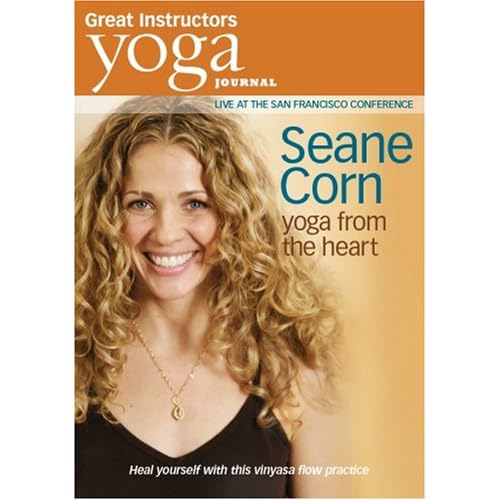
New Seane Corn Yoga DVD - FANTASTIC!


Seane at her best. Live, relational and as genuine as can be. Many of you know I have followed Seane's teaching and growth as a teacher and spiritual leader for years now. She 'walks the talk' and is what yoga is all about. Authenticity and compassion. Untrapped by her celebrity - she uses her platform to make a difference in the world by taking yoga "Off the Mat and Into the World" through her spiritual activism . A truly gifted and extremely intelligent spirit. This DVD will make for wonderful home practice. Integrates the beauty of the vinyasa practice with a wonderful sense of spirituality.

A must have! Out of 5 stars - I give it 10!!!!

"Heal yourself-and the world-through yoga. Filmed live at the Annual Yoga Journal San Francisco Conference, this unrehearsed 90-minute class captures the charisma and soul of one of yoga's great instructors. In this heart-pumping vinyasa flow practice, you'll journey through your body to awaken to your own intuition and life purpose and gain insight into how your yoga practice can empower you to help heal the world. One of the most gifted yoga instructors in America, Seane Corn's dynamic and inspirational style of yoga incorporates both the physical and spiritual aspects of yoga. She is the National Yoga Ambassador for YouthAIDS and the recipient of the 2005 Conscious Humanitarian Award. Seane teaches at Sacred Movement in Santa Monica, California and travels extensively. Learn 32 poses in all, including: Sun Salutations; standing poses; hip openers, and shoulder and spine stretches - Stand-alone chapters allow you to start the class at any point - In-depth interview with Seane Corn"

Wednesday, November 14, 2007

EXERCISE BUILDS STRONG BRAINS!

We’ve known for many years about the physiological benefits of exercise. Certainly it’s good for our hearts, lungs and muscles. Recently, studies have shown the remarkable effect regular exercise has on our brains and mental wellness.

I’ve referred to it as “medicine’s dirty little secret”. In head to head studies, regular aerobic exercise has been shown to be just about as effective as certain popular anti-depression medications for treating clinical depression.

Here’s a recent study reported in USA Today that suggests regular exercise has a significant impact on helping children focus on schoolwork, impulse control and organization. Here’s the story…

By Nanci Hellmich, USA TODAY

Kids who play hard every day may be making their brains, as well as their bodies, stronger. A new study reports that children who play vigorously for 20 to 40 minutes a day may be better able to organize schoolwork, do class projects and learn mathematics.

"Children who are not active may be at a disadvantage academically," says Catherine Davis, an associate professor of pediatrics at the Medical College of Georgia in Augusta. She presented the research last week at the annual meeting of the Obesity Society, a group of weight-loss professionals.

Davis and colleagues worked with 163 sedentary, overweight children, ages 7 to 11, for three months. The children were divided into three groups: a control group that did no physical activity after school; a group that did 20 minutes of vigorous physical activity five days a week after school; and a group that did 40 minutes of such activity on those same days.

The activity groups played intermittent, high-energy running games, such as flag tag, relays, jump rope and modified basketball. They wore heart-rate monitors and were given rewards for maintaining a high average heart rate. Students also were given cognitive-function tests at the beginning and end of the study. They were tested for their math and reading achievement and "executive function."

Executive function includes skills important for planning and organizing, focusing on schoolwork, resisting impulses, self-monitoring and using strategies to achieve goals. Children who have attention deficit disorder have difficulty with those tasks.

Among the findings from the National Institutes of Health-financed study:

  • The children in the 40-minute activity group had significant improvement on an executive-function test compared with the control group. They increased about 4 points on a cognitive-performance scale. Those in the 20-minute group showed about half that improvement.
  • There was a small improvement in math achievement for both exercise groups but no signs of improvement in reading.
  • Those in the exercise groups lost about 1% to 2% of body fat.

The researchers also performed brain scans and found that the children who were exercising appeared to have more neural activity in the frontal areas of their brains, an important area for executive function, Davis says. "The animal literature tells us that exercise, particularly regular exercise, stimulates the growth of blood vessels and neurons in the brain, so we think the same may be happening in the children."

Other studies have shown that executive function improves in older adults who become more physically active, she says. "School systems need to know that to reach their achievement targets, they need to add physical activity to the school day rather than reduce it."

Phillip Tomporowski, a study co-author and exercise psychologist at the University of Georgia in Athens, says exercise "may well improve the underlying mental processes that are involved in a lot of behaviors and academic tasks."

Says Darla Castelli, assistant professor in the department of kinesiology and community health at the University of Illinois at Urbana-Champaign: "This research corroborates several of our studies, which have also examined executive function in kids. We found strong associations between math performance and aerobic fitness among elementary-school-age children."

Howell Wechsler, director of the Division of Adolescent and School Health for the Centers for Disease Control and Prevention, says some children don't have as many opportunities outside school to be as active as children in previous generations.

"Today there is so much more competition for their time with all the attractive options to be sedentary, from hundreds of cable stations to video games and computer games," Wechsler says. "This makes it even more important to have physical education programs and other opportunities for physical activity at school."

So, if your kids aren’t exercising in school (many schools have cut P.E. from their curriculum) it will help them physically and mentally to be involved in some structured aerobic activity. I promise you, a half hour of vigorous activity will reap far more benefit than a half hour staring at a video screen playing the latest game!

And, we adults get a similar benefit from exercise – what a great reason to get the whole family together. Go for a jog or walk, kick a soccer ball around, smack a table tennis ball … you, your family and your brain will be glad you did!

To Your Brain Health,

Daniel

Daniel Amen, M.D.
CEO, Amen Clinics, Inc.
Distinguished Fellow, American Psychiatric Association

New Meetup Group: Gay Mens Yoga and Meditation Group

Monday, November 12, 2007

10 Ways to Outwit Your Appetite

You don't have to be smarter than a quiz-show fifth-grader to learn how to control the urge to eat. Just follow these ingenious tips to keep your appetite under wraps:

Feed it protein for breakfast. You'll be less hungry later on and end up eating 267 fewer calories during the day. At least that's what happened on days when St. Louis University researchers gave overweight women two scrambled eggs and two slices of jelly-topped toast for breakfast rather than about half that protein.

Make it climb a flight of stairs. At home, store the most tempting foods way out of reach. For instance, Cornell University food psychologist Brian Wansink, PhD, keeps his favorite soda in a basement fridge. "Half the time I'm too lazy to run down there to get it, so I drink the water in the kitchen."

Sleep on it. People who don't get their 8 hours of ZZZs experience hormonal fluctuations that increase appetite, report researchers. Learn more about how sleep affects your diet.

Give it something else to think about. When scientists scanned the brains of people eating different foods, they found that the brain reacts to fat in the mouth in much the same way that it responds to a pleasant aroma. So if you feel a craving coming on, apply your favorite scent.

Never let it see a heaping plate. The more food that's in front of you, the more you'll eat. So at a restaurant, ask your waiter to pack up half of your meal before serving it to you, then eat the extras for lunch the next day.

Put it under the lights. You consume fewer calories at a well-lit restaurant table than you do dining in a dark corner. "In the light, you're more self-conscious and worry that other patrons are watching what you eat," explains Wansink.

Talk it down. Entertaining friends with a great story doesn't give you much time to eat up, so you'll probably still have food on your plate when they're done. Once they're finished, call it quits, too.

Offer it a seat. If you sit down to snack -- and use utensils and a plate -- you'll eat fewer calories at subsequent meals.

Satisfy it with soup. Start lunch with about 130 calories worth of vegetable soup and you'll eat 20% fewer calories overall during lunch, say Penn State experts.

Give it little choice. Packages that contain assorted varieties of cookies, candy, dips, cheese, etc., make you want to try all the flavors. The effect is so powerful, says Wansink, that when people are given 10 colors of M&Ms to munch on, not 7, they eat 30% more!

Oh, and one more thing: Feeding your appetite a diverse diet that is low in calories and high in nutrients can make your RealAge as much as 4 years younger. Sweet.

Sunday, November 11, 2007

Candidate Calculator: Which 2008 Presidential Candidate Agrees With You?

Answer the questions on the link to find the 2008 presidential candidate that best aligns with your beliefs. More than 1 million people have already filled it out. Give it a try!

As featured on CNN: The Situation Room

Candidate Caculator

Saturday, November 10, 2007

New Vegetarian Cookbook and another CONSIDERATION for choosing more vegetarian options

Author of a dozen bestselling cookbooks and beloved columnist for The New York Times ("The Minimalist"), Chef Mark Bittman bookends his award-winning modern classic, How to Cook Everything, with How to Cook Everything: Vegetarian the ultimate one-stop resource for meatless meals. Refreshingly straightforward and filled with illustrated recipes, this is a book that puts vegetarian cuisine within the reach of every home cook. You'll want to spend countless days in the kitchen with Bittman's latest culinary treasure.

"First off, we eat too much of that stuff for our health; every single responsible, independent, and impartial study shows as much. But they also show that replacing the beef in your diet with potato chips and soda won’t do you any good. You can be a “vegetarian” and still eat plenty of food that’s bad for you".

"Secondly, the production of animal products as food is a major contributor to global warming. See the UN Report entitled Livestock’s Long Shadow (http://www.fao.org/docrep/010/a0701e/a0701e00.htm), which says, ultimately, that 18 percent of greenhouse gasses are a direct result of the production of animals for human consumption. " - Mark Bittman

Order the book here: Amazon.com: How to Cook Everything Vegetarian: Simple Meatless Recipes for Great Food (How to Cook Everything): Books: Mark B. it just came out a few weeks ago and already has received mostly 5 stars. I just made the black bean burgers with cashews and carrots below which is his recipe and they are fantastic!

And I would add the Hindu concept of AHIMSA - doing non-violence to self or other sentient beings (which includes animals!)..Ahimsa (Devanagari: अहिंसा; IAST ahiṃsā) is a Sanskrit term meaning non-violence (literally: the avoidance of violence - himsa) It is an important tenet of the religions that originated in ancient India (Hinduism Buddhism and especially Jainism). Ahimsa is a rule of conduct that bars the killing or injuring of living beings It is closely connected with the notion that all kinds of violence entail negative karmic consequences The extent to which the principle of non-violence can or should be applied to different life forms is controversial between various authorities movements and currents within the three religions and has been a matter of debate for thousands of years... More info at http://en.wikipedia.org/wiki/Ahimsa

Black Bean Burgers with Cashews and Carrots
From Chef Mark Bittman
Makes 6 burgers

The marvelous Mark Bittman gave us the idea for combining black beans and oats for a burger that has great texture and looks just like the real thing. These are fine plain, with a squeeze of lemon, or with a big spoonful of Avocado and Black Bean Salsa.

Note: If you cook the beans yourself, take them off the heat and drain them while they still retain a little texture.

1 large celery rib, coarsely cut up
1 medium-large carrot, peeled and shredded
12 large roasted cashews
2 cups cooked or canned organic black beans, rinsed and drained well
1/3 cup steel-cut oats
1 1/2 teaspoons organic vegetable bouillon powder
1 teaspoon ground cumin
1 teaspoon rice vinegar
1 tablespoon extra virgin olive oil, plus more for the pan
Yellow cornmeal

Put the celery, carrot, and cashews in a food processor. Pulse to chop coarsely. Add the beans, oats, bouillon powder, cumin, vinegar, and 1 tablespoon olive oil. Pulse until just mixed evenly. Cover and refrigerate for at least 2 hours, or overnight.

Form the bean mixture into 6 patties. Dust lightly with cornmeal to coat both sides. Heat the olive oil in a large skillet over medium heat. Add the patties and sauté for 2 to 3 minutes on each side, until lightly browned. Or bake in a 375 degree F oven for about 15 minutes. Let sand for 2 to 3 minutes to firm up before serving.

Tuesday, November 06, 2007

Air Fresheners Leave Your Indoor Air Anything But

There’s always been a something a little unsettling about the idea of revitalizing the air inside our homes by spraying things with names like “Meadow Mist” and “Mountain Breeze” all over the place, especially when such products hardly smell like either. Now two new studies have found that our suspicions were correct: synthetic air fresheners are coating our homes and filling our air with unsafe chemicals.

Used in 75% of American households, air fresheners are a huge industry that generates sales of $1.72 billion a year. Found in everything from plug-in disposable appliances and fake candles to sprays and peel-and-stick evaporative disks, these products don’t actually eliminate odors but merely use one of several strategies to make you think they’ve vanished. Some products simply cover up bad smells with stronger chemicals. Some use a nerve-deadening agent to reduce your ability to smell in the first place; while others coat the inside of your nasal passages with a film that stops smells from getting through. Now a new study from the Natural Resources Defense Council (NRDC) finds they’re doing something else as well: polluting our indoor air whenever we use them.

The NRDC tested 14 different air fresheners, including those labeled “all-natural,” and found that all but two contained measurable levels of phthalates, synthetic chemicals linked to asthma, endocrine disruption, and other serious health problems. (For more about phthalates see the February 2006 issue of the Non-Toxic Times at http://www.seventhgeneration.com/making_difference/newsletter_article.php?article=110&issue=25.) The amounts of phthalates found ranged from 0.12 parts per million (ppm) to an extraordinary 7,300 ppm. Only two of the tested products contained no phthalates at all.

Researchers said that though the number of products tested was small and couldn’t be said to form a representative sampling, the study’s results clearly indicate the need for more comprehensive testing of these common consumer products, especially in light of the fact that the federal government neither tests air fresheners nor requires their manufacturers to list product ingredients or adhere to any specific safety standards.

In response to the study, Walgreens stores, whose private label air fresheners contained the highest levels of phthalates reported by the study, removed the offending products from their shelves in a commendable example of a company taking swift action to right a toxicological wrong.

Hot on the heels of that decision came news of a study published in the American Journal of Respiratory and Critical Care Medicine, which found that the use of spray cleaners in general greatly increases the risk of contracting asthma. Researchers in Barcelona, Spain found that test subjects who used spray cleaners at least once a week had a 30-50% greater chance of developing this respiratory disease and concluded that as many as one in seven cases of adult asthma could be blamed on exposure to spray cleaners. The study singled out conventional glass cleaners, furniture sprays, and air fresheners as particularly likely to trigger the ailment.

Clearly, conventional air fresheners have no place in a healthy home. In addition to phthalates, air freshener toxins can include naphthalene, phenol, cresol, dichlorobenzene, and xylene among many others. These chemicals have been implicated in cancer, neurological damage, reproductive and developmental disorders and other conditions.

For these reasons, indoor air quality experts recommend against using air fresheners or room deodorizes of any kind. Instead, try these safe methods to freshen the air in your home:

• Locate sources of odors and eliminate them when and wherever possible. Since many odors are the result of microbial action, spraying trouble spots and potentially problematic areas (like trash cans, compost containers, etc.) with an undiluted 3 percent solution of hydrogen peroxide (the concentration typically available in stores) will remove many odors.

• Use natural minerals like baking soda and borax to control common odor sources and to deodorize when you clean.

• Keep windows open as much as possible to let bad air out and good air in. If odors are still troubling, invest in an air purifier with activated carbon filtration, a strategy that can remove odors.

• To scent indoor air, place a drop of a natural essential oil like lavender or mint on a cold light bulb, or add a dozen drops to a bowl of water placed on a radiator or wood stove. You can also boil fragrant dried herbs in a pot of water to release a fresh smell.

• A natural mineral called zeolite is available in packets that will absorb odors when hung in problem areas like musty basements and closets.

• Make your own sprays from essential oils and other natural ingredients. For recipes and more information, we recommend the book Better Basics for the Home, by Annie Berthold Bond.

To learn more about the NRDC study, visit http://www.nrdc.org/health/home/airfresheners/contents.asp. For more information about the research published by the American Journal of Respiratory and Critical Care Medicine, please see http://ajrccm.atsjournals.org/cgi/content/abstract/176/8/735.


Tuesday, October 30, 2007

Saturday, October 27, 2007

Lessons in living: Final lecture from professor with pancreatic cancer


Carnegie Mellon Professor Randy Pausch, who is dying from pancreatic cancer, gave his last lecture at the university Sept. 18, 2007, before a packed McConomy Auditorium. In his moving talk, "Really Achieving Your Childhood Dreams," Pausch talked about his lessons learned and gave advice to students on how to achieve their own career and personal goals.

"Almost all of us have childhood dreams; for example, being an astronaut, or making movies or video games for a living. Sadly, most people don’t achieve theirs, and I think that’s a shame. I had several specific childhood dreams, and I’ve actually achieved most of them. More importantly, I have found ways, in particular the creation (with Don Marinelli), of CMU’s Entertainment Technology Center of helping many young people actually *achieve* their childhood dreams." - Randy Pausch

Thursday, October 25, 2007

Meditation Boosts Mood, Immune System

Meditation May Put a Positive Spin on Emotion, Immune System

WebMD Medical News

Aug. 18, 2003 -- Boosting your immune system may be as simple as putting mind over matter.

A new study shows that meditation can help produce antibodies against illness and also lift your spirits.

Researchers say biological effects seen in the study are long lasting -- up to four months after the end of meditation training. Previous research has focused only on more immediate effects. The new study appears in the latest issue of Psychosomatic Medicine.

Researchers measured brain electrical activity in 48 people at several points in the study. At each measurement, the volunteers wrote about one of three of the most positive and negative experiences in their life.

To measure immune response, researchers took blood samples twice after the volunteers got a flu shot. This allowed them to examine how many antibodies the volunteers produced in response to the vaccine.

Additionally, half of the volunteers took a meditation class that met once a week for two to three hours. Researchers also assigned formal and informal meditation practices that they were supposed to do at home one hour a day, six days a week -- with the help of guided audiotapes.

Meditation Helps

Meditation helped on two fronts. People who meditated had the most brain activity in the part of the brain linked to positive emotion and they had higher levels of antibodies than those who didn't meditate. Researchers also say that the increase brain activity was directly linked to the antibody increase among people who meditated.

Researchers say more studies are needed in this area, calling the results "informative but saying little about changes that are more enduring."

Monday, October 22, 2007

Help stop abuse of these "lab" monkeys @ UCSF

YOU HAVE A RIGHT TO KNOW!


http://support.pcrm.org/site/R?i=LXN1QfnMX1omJAF6QwhF3w..


It’s hard to believe but around the country, taxpayers’ dollars are being used to fund cruel animal tests—even though they often violate the Animal Welfare Act! It’s truly horrifying.

PCRM is in the midst of a lawsuit against the University of California, San Francisco (UCSF)—the latest example of this unlawful cruelty to animals. But we need your help!

A letter you have just received from me (or are about to receive) has more details on this disturbing case. You’ll read about how a group of concerned citizens alerted us of the atrocities at UCSF:

  • Drilling holes into the skulls of monkeys
  • Bolting metal restraining devices into their heads
  • Making them “work” to receive “rewards” like water

PCRM relies on activists like them—and like you—to help us protect and save more animals from unnecessary death. We must work together to make a difference!

I urge you to help protect animals in your own community. You can find tools to help you on our Web site.

But to make an immediate difference and help our case against UCSF, please make a generous gift to PCRM today.

Your contribution will help PCRM show that concerned citizens will not allow schools or corporations to violate the Animal Welfare Act or use state or federal funding to torture defenseless animals.

Please do your part—make a donation today!

Thank you for all you do,

Dr.

Neal Barnard, M.D.
PCRM President

Thursday, October 18, 2007

Hidden Anger of Gay Men- Wonder Why?

Univ. of Vermont Nearly Boycotts Red Cross Blood Drive Over Exclusion of Gay Men

The University of Vermont’s student government narrowly voted Tuesday against forbidding the American Red Cross to collect blood on campus after considering a resolution to boycott drives because gay men aren’t allowed to donate, according to the Associated Press.

After more than three hours of discussion and debate, the university’s Student Government Association rejected the boycott resolution 16-15.

The federal Food and Drug Administration enacted the policy in 1983, and all blood collection organizes must follow it. Supporters of the student government resolution argued that FDA policy contradicts the university’s nondiscrimination standards.

Gay men who aren’t allowed to donate blood “are essentially being told that they’re bad and dirty,” Dot Brauer, director of the school’s Lesbian Gay Bisexual Transgender Questioning and Allied Services, told the AP. Hosting the Red Cross on campus, she said, “indicates our agreement.”

Red Cross officials told the AP on Tuesday that they disagree with FDA policy and have requested that it be changed. (The Advocate)


Wednesday, September 26, 2007

Mindful Awareness: Gathas

Choose a Gatha
"Gathas are short verses that we can recite during our daily activities to help us return to the present moment and dwell in mindfulness. As exercises in both meditation and poetry, gathas are an essential part of Zen Buddhist tradition. Using a gatha doesn't require any special knowledge or religious practice. Some people like to memorize a favorite verse that they find they can come back to again and again. Others just like to write the verse down in a place they are likely to see it often. . . .

"Reciting gathas is one way to help us dwell in the present moment. When we focus our mind on a gatha, we return to ourselves and become more aware of each action. When the gatha ends, we continue our activity with heightened awareness. When we drive a car, signs can help us find our way. The sign and the road become one, and we see the sign all along the way until the next sign. When we practice with gathas, the gathas and the rest of our life become one, and we live our entire lives in awareness. This helps us very much, and it helps others as well. We find that we have more peace, calm, and joy, which we can share with others."

— Thich Nhat Hanh in Present Moment Wonderful Moment. Reprinted by permission of Parallax Press.

To Practice This Today:

Here are five gathas from Present Moment Wonderful Moment; commentaries on them appear in the book. Or feel free to make up your own verses. Write them down, reflect on them and repeat them often during the day.

Waking Up
Waking up this morning, I smile.
Twenty-four brand new hours are before me.
I vow to live fully in each moment
and to look at all beings with eyes of compassion.

Turning on the Television
The mind is a television with thousands of channels.
I choose a world that is tranquil and calm
so that my joy will always be fresh.

Washing Our Hands
Water flows over these hands.
May I use them skillfully
to preserve our precious planet.

Walking
The mind can go in a thousand directions,
but on this beautiful path, I walk in peace.
With each step, a gentle wind blows.
With each step, a flower blooms.

Brushing Your Teeth
Brushing my teeth and rinsing my mouth,
I vow to speak purely and lovingly.
When my mouth is fragrant with right speech,
a flower blooms in the garden of my heart.

Supplement may reduce addictive behaviors

N-Acetyl Cysteine May Help Reduce Gambling and Other Addictions

Breaking News
By VRP Staff

Researchers have released the results of a new study that indicates supplementation with N-Acetyl Cysteine (NAC) may reduce addictive behavior in compulsive gamblers as well as individuals with other addictions.

N-acetyl cysteine is thought to restore extracellular concentrations of the chemical glutamate, which is often associated with reward in the brain. This ability led researchers to believe NAC could have a promising role to play in minimizing addictive behavior. The researchers enrolled 27 pathological gamblers (12 women) in an 8-week trial of NAC. The first part of the study was an open trial where subjects each consumed daily doses of NAC. In this part of the study, 16 of 27 subjects (59.3 percent) reported experiencing less urges to gamble. The effective dose of NAC ranged from 1,100 to 1,700 mg per day.

Of those 16 subjects, 13 went on to participate in a double-blind, randomized, placebo-controlled trial of NAC. Of those subjects given NAC, 83.3 percent experienced a reduced compulsion to gamble compared with only 28.6 percent of those assigned to a placebo.

The study authors concluded, “The efficacy of NAC lends support to the hypothesis that pharmacological manipulation of the glutamate system might target core symptoms of reward-seeking addictive behaviors such as gambling. Larger, longer, placebo-controlled, double-blind studies are warranted.”

Similar studies of N-acetyl cysteine have shown it can curb drug addictions in animals. However, the researchers of the current study believe their study was the first to look at the effects of a glutamate-modulating agent in pathological gamblers. The researchers are currently investigating whether NAC could help methamphetamine users quit.

Reference:

Grant JE, Kim SW, Odlaug BL. N-acetyl cysteine, a glutamate-modulating agent, in the treatment of pathological gambling: a pilot study. Biol Psychiatry. 2007 Sep 15;62(6):652-7.

Friday, September 14, 2007

Did you know THIS about our world?

Wait till you check this out!

Did you know this about our world?

Wednesday, August 29, 2007

Help Stop Dog Fighting


Click here for what you can do to make a difference

Wednesday, August 08, 2007

Dear Dr. Laura

Dear Dr. Laura,

Thank you for doing so much to educate people regarding God's Law. I have learned a great deal from your show, and I try to share that knowledge with as many people as I can. When someone tries to defend the homosexual lifestyle, for example, I simply remind him that Leviticus 18:22 clearly states it to be an abomination. End of debate.

I do need some advice from you, however, regarding some of the specific laws and how to best follow them.

  1. When I burn a bull on the altar as a sacrifice, I know it creates a pleasing odour for the Lord (Lev. 1:9). The problem is my neighbors. They claim the odour is not pleasing to them. Should I smite them?
  2. I would like to sell my daughter into slavery, as sanctioned in Exodus 21:7. In this day and age, what do you think would be a fair price for her?
  3. I know that I am allowed no contact with a woman while she is in her period of menstrual uncleanliness (Lev. 15:19-24). The problem is, how do I tell? I have tried asking, but most women take offense.
  4. Lev. 25:44 states that I may indeed possess slaves, both male and female, provided they are purchased from neighboring nations. A friend of mine claims that this applies to Mexicans, but not Canadians. Can you clarify? Why can't I own Canadians?
  5. I have a neighbor who insists on working on the Sabbath. Exodus 35:2 clearly states he should be put to death. Am I morally obligated to kill him myself?
  6. A friend of mine feels that even though eating shellfish is an abomination (Lev. 11:10), it is a lesser abomination than homosexuality. I don't agree. Can you settle this?
  7. Lev. 21:20 states that I may not approach the altar of God if I have a defect in my sight. I have to admit that I wear reading glasses. Does my vision have to be 20/20, or is there some wiggle room here?
  8. Most of my male friends get their hair trimmed, including the hair around their temples, even though this is expressly forbidden by Lev.19:27. How should they die?
  9. I know from Lev. 11:6-8 that touching the skin of a dead pig makes me unclean, but may I still play football if I wear gloves?
  10. My uncle has a farm. He violates Lev. 19:19 by planting two different crops in the same field, as does his wife by wearing garments made of two different kinds of thread (cotton/polyester blend). He also tends to curse and blaspheme a lot. Is it really necessary that we go to all the trouble of getting the whole town together to stone them? (Lev.24:10-16) Couldn't we just burn them to death at a private family affair like we do with people who sleep with their in-laws? (Lev.20:14)

I know you have studied these things extensively, so I am confident you can help. Thank you again for reminding us that God's word is eternal and unchanging.

Your devoted disciple and adoring fan,

Friday, August 03, 2007

Researchers Compile 237 Reasons for Sex


August 1, 2007

WASHINGTON (AP) -- After exhaustively compiling a list of the 237 reasons why people have sex, researchers found that young men and women get intimate for mostly the same motivations. It's more about lust in the body than a love connection in the heart.

College-aged men and women agree on their top reasons for having sex -- they were attracted to the person, they wanted to experience physical pleasure and "it feels good," according to a peer-reviewed study in the August edition of Archives of Sexual Behavior. Twenty of the top 25 reasons given for having sex were the same for men and women.

Expressing love and showing affection were in the top 10 for both men and women, but they did take a back seat to the clear No. 1: "I was attracted to the person."

Researchers at the University of Texas spent five years and their own money to study the overlooked why behind sex while others were spending their time on the how.

"It's refuted a lot of gender stereotypes ... that men only want sex for the physical pleasure and women want love," said University of Texas clinical psychology professor Cindy Meston, the study's co-author. "That's not what I came up with in my findings."

Forget thinking that men are from Mars and women from Venus, "the more we look, the more we find similarity," said Dr. Irwin Goldstein, director of sexual medicine at Alvarado Hospital in San Diego. Goldstein, who wasn't part of Meston's study, said the Texas research made a lot of sense and adds to growing evidence that the vaunted differences in the genders may only be among people with sexual problems.

Meston and colleague David Buss first questioned 444 men and women -- ranging in age from 17 to 52 -- to come up with a list of 237 distinct reasons people have sex. They ranged from "It's fun" which men ranked fourth and women ranked eighth to "I wanted to give someone else a sexually transmitted disease" which ranked on the bottom by women.

Once they came up with that long list, Meston and Buss asked 1,549 college students taking psychology classes to rank the reasons on a one-to-five scale on how they applied to their experiences.

"None of the gender differences are all that great," Meston said. "Men were more likely to be opportunistic towards having sex, so if sex were there and available they would jump on it, somewhat more so than women. Women were more likely to have sex because they felt they needed to please their partner."

But this is among college students, when Meston conceded "hormones run rampant." She predicted huge differences when older groups of people are studied.

Since her study came out Tuesday, people are coming up with new reasons to have sex.

"Originally, I thought that we exhaustively compiled the list, but now I found that there should be some added," Meston said.

Copyright 2007 The Associated Press. All rights reserved. This material may not be published, broadcast, rewritten or redistributed.

Sunday, July 29, 2007

Failure is the way to go?

It turns out that failure is the way we learn best--presuming we don't get too much of it at any one time. And the article helps explain why.

THE ATTRIBUTIONS WE MAKE

Of course, through disappointment and failure we learn how to cope. Welearn what we can cope with. Success is great, but it often misleads us.We tend to internalize success, erroneously ascribing it to our ownstellar innate characteristics--while overlooking the often-powerful handof luck or special opportunity. On the other hand, we tend to attribute failure to general conditions Out There or to adverse circumstances. Weoften do this so we can look ourselves in the mirror in the morning.

PRESSURES FOR SUCCESS

Our culture these days is especially focused on success. The economy is doing quite well and so success stories abound. Our taste for having things and displaying status is riding high. People are focused on the pathways to success. Of course, there are signals that focusing on success is not always psychically sustainable: The pressure to achieve has an uncanny way of promoting perfectionism, and disorders ofperfectionism are rampant. Eating disorders are only the most visible.Think about anxiety disorders related to obsessiveness, the ubiquity ofstress, and burnout especially among young athletes who push theirbodies beyond their limits.

A DIFFERENT DIRECTION

The new article, which appeared in the May issue of the Journal of Cognitive Neuroscience, turns my head in a completely different direction. What I like about it is that it shows precisely how we learn more from our mistakes than we do from getting things right. Bydefinition, mistakes violate our own expectations. The surprise indiscovering we are wrong is particularly conducive to learning--it galvanizes our attention, amplifies it, and speeds up our ability to detect the possibility of error the next time around.

PRIORITY PROCESSING

The need to learn from mistakes is so crucial--in our ancient past on the savannah it likely saved lives and is the reason why our ancestors survived and we can strut our stuff today-- it is allocated priority processing in the brain. Psychologist Andy Wills and colleagues at the University of Exeter in England report that when we come up against things for which we earlier made incorrect predictions, the brain sendsout a signal of recognition. It does this amazingly quickly--in just one-tenth of a second--almost immediately after seeing the object that first foiled us, in an effort to prevent us from repeating the error.This happens automatically, long before there is time for conscious consideration.

ANOTHER CHANCE

Learning, then, hinges on the surprise of getting things wrong. Failure,after all, is just information, a signal to try something else, anotherchance to learn. But failure is information--and not a fixed and frozen outcome or catastrophe--only if people are allowed to see themselves as problem-solvers, secular scientists learning by trial and error, and notas totems of talent or perfection who need to look smart and always produce the right answer.

PROMOTING FAILURE

We need to fail more often and we need to get more comfortable with the concept of failure--not always see it as a negative, and especially not as a negative reflection on our innermost self. If we never fail, it means we're not testing our limits; we don't know who, or what, we are.

Experimentation is the true mother of success. Many inventions--Velcro is one--grew from accidents that were at first looked on as failures.Experimentation demands tolerance for mistakes, and without either one of them innovation is as good as dead. In the absence of innovation, our economy has little ability to sustain itself in the global marketplace. Our future depends as much on failure as it does on success.

Friday, July 27, 2007

Security, Change, Fear - a thought

Security is mostly a superstition. It does not exist in nature nor do the children of humankind as a whole experience it. Avoiding danger is no safer in the long run than outright exposure. Life is either a daring adventure, or nothing. To keep our faces towards change and behave like free spirits in the presence of fate is strength undefeatable!-- Helen Keller 1940

Saturday, July 21, 2007

EQUALITY? Hardly...

R.I. governor blocks bill requiring infertility treatment coverage for the unmarried

Rhode Island governor Don Carcieri has vetoed a bill requiring health insurers to cover infertility treatments for unmarried people, saying they shouldn't be forced to subsidize out-of-wedlock births.

The Republican governor, who opposes same-sex marriage and civil unions, warned that eliminating the marriage restriction would also drive up health care costs.

''As a matter of public policy, the state should be encouraging the birth of children to two-parent families, not the reverse,'' he said in a written statement Thursday announcing his Wednesday veto.

Two weeks ago Carcieri permitted another bill to become law without his signature that required insurers to increase the age cap on eligible women to 42 from 40. It also required insurers to pay for infertility treatments after a couple fails to conceive or carry a pregnancy after one year of trying, instead of two.

But Carcieri balked when Democratic state representative Edith Ajello's bill went one step further and eliminated the marriage requirement.

Ajello, a prominent supporter of same-sex marriage, said her legislation could benefit heterosexual couples who choose not to wed, lesbian couples barred from marrying in Rhode Island, and single women. She said infertility treatment can cost as much as $20,000, making it prohibitively expensive without insurance coverage.

''I do think it's an issue of civil rights, of discrimination, of not looking at people with an equal eye,'' Ajello said. ''I think we get into a very potentially dangerous situation when we decide who should have children and who shouldn't.'' (Ray Henry, AP)

Thursday, July 12, 2007

Burger King to Use Trans-Fat-Free Oil


July 6, 2007

MIAMI (AP) -- Burger King said Friday it will use trans-fat-free cooking oil at all its U.S. restaurants by the end of next year, following in the footsteps of other leading fast-food restaurants.

The world's second largest hamburger chain said it was already using zero trans-fat oil in hundreds of its more than 7,100 U.S. restaurants nationwide.

Burger King is known for its flame-broiled burgers, but uses cooking oil for its french fries and most of its chicken products.

In tests, consumers determined that more than a dozen items cooked in the new oil, such as french fries and hash browns, tasted the same or better than products cooked in the trans-fat oil, the company said.

Miami-based Burger King Corp. said two trans-fat-free oil blends passed tests. If adequate supply becomes available, the U.S. rollout of the oils could be completed sooner than 2008, the company said.

Trans fats are listed on food labels as partially hydrogenated vegetable oil. They can raise bad cholesterol and lower healthy cholesterol, increasing the risk of heart disease, doctors say.

Critics have said Burger King was taking too long to move toward the healthier oils. The Washington-based Center for Science in the Public Interest sued Burger King in May, saying the company was moving too slowly and had failed to set a definite timetable for removal of trans fats.

In response to the lawsuit, Burger King said in May it expected to begin the national rollout its new zero trans-fat oil by the end of this year.

Among Burger King's main competitors, McDonald's Corp. said earlier this year it had selected a new trans-fat-free oil. Wendy's International Inc. started using cooking oil with zero grams of trans fat in August 2006.

Starbucks Corp. announced in May that it will cut artificial trans fats out of food and drinks in its stores in the continental United States, Alaska and Canada by the end of the year.

Yum Brands Inc. said in April that all of its KFC restaurants are now serving fried chicken with zero grams of trans fats. Yum Brands also said its Taco Bell restaurants switched to a trans fat-free frying oil.

Burger King is owned by Burger King Holdings Inc. and operates more than 11,200 restaurants worldwide. About 90 percent its restaurants are owned and operated by franchisees.

Copyright 2007 The Associated Press. All rights reserved. This material may not be published, broadcast, rewritten or redistributed.

Tuesday, July 10, 2007

Michael Moore Confronts CNN Inaccuracies


To check out Michael Moore's point by point arguments supporting his facts in the making of SiCKO, confronting the inaccuracies in Dr. Sanjay Gupta's CNN story, click here.

Truth. We have 47 million people in the USA who are uninsured and without access to health care. The result is 18,000 people who die each year simply because they do not have health insurance - that is the body count of six 9/11's.

Your vote counts! Time to demand from our politicians CHANGE though universal health care!

Wednesday, July 04, 2007

On "Forwarded Jokes and Emails"

A man and his dog were walking along a road. The man was enjoying the scenery, when it suddenly occurred to him that he was dead.He remembered dying, and that the dog walking beside him had been dead for years. He wondered where the road was leading them.

After a while, they came to a high, white stone wall along one side of the road. It looked like fine marble. At the top of a long hill, it was broken by a tall arch that glowed in the sunlight.

When he was standing before it he saw a magnificent gate in the arch that looked like mother-of-pearl, and the street that led to the gate looked like pure gold. He and the dog walked toward the gate, and as he got closer, he saw a man at a desk to one side.

When he was close enough, he called out, "Excuse me, where are we?"

"This is Heaven, sir," the man answered.

"Wow! Would you happen to have some water?" the man asked.

"Of course, sir. Come right in, and I'll have some ice water brought right up."

The man gestured, and the gate began to open.

"Can my friend," gesturing toward his dog, "come in, too?" the traveler asked.

"I'm sorry, sir, but we don't accept pets."

The man thought a moment and then turned back toward the road and continued the way he had been going with his dog.

After another long walk, and at the top of another long hill, he came to a dirt road leading through a farm gate that looked as if it had never been closed. There was no fence.

As he approached the gate, he saw a man inside, leaning against a tree and reading a book.

"Excuse me!" he called to the man. "Do you have any water?"

"Yeah, sure, there's a pump over there, come on in."

"How about my friend here?" the traveler gestured to the dog.

"There should be a bowl by the pump."

They went through the gate, and sure enough, there was an old-fashioned hand pump with a bowl beside it.

The traveler filled the water bowl and took a long drink himself, then he gave some to the dog.

When they were full, he and the dog walked back toward the man who was standing by the tree.

"What do you call this place?" the traveler asked.

"This is Heaven," he answered.

"Well, that's confusing," the traveler said. "The man down the road said that was Heaven, too."

"Oh, you mean the place with the gold street and pearly gates? Nope. That's hell."

"Doesn't it make you mad for them to use your name like that?"

"No, we're just happy that they screen out the folks who would leave their best friends behind."

Soooo...

Sometimes, we wonder why friends keep forwarding jokes to us without writing a word.

Maybe this will explain.

When you are very busy, but still want to keep in touch, guess what you do? You forward jokes.

When you have nothing to say, but still want to keep contact, you forward jokes.

When you have something to say, but don't know what, and don't know how, you forward jokes.

Also to let you know that you are still remembered, you are still important, you are still loved, you are still cared for, guess what you get?

A forwarded joke.

So, next time if you get a joke, don't think that you've been sent just another forwarded joke, but that you've been thought of today and your friend on the other end of your computer wanted to send you a smile.

You are all welcome @ my water bowl anytime

Monday, July 02, 2007

Brain mapping leads to optimal function

Offers holistic way of treating mental woes

Pat Whitney
Jan. 5, 2005 12:00

AM As recently as 15 years ago, medical science considered the human brain complete at birth and unchangeable.

Now, proof of brain plasticity - that the brain can be physically changed - is leading neuroscientists to discover innovative ways of treating brain dysfunction.

When the Dr. Phil television show hosted a feature on alternative treatments for attention deficit Disorder and other cognitive problems this fall, Jeffrey Fannin, Ph.D., director of the Center of Cognitive Enhancement in Glendale, took note.


A doctor on the show was demonstrating brain mapping to achieve optimal brain function, using the same equipment Fannin uses on his patients locally.

One patient is Alex Goode, 12, a seventh-grader at Highland Lakes Middle School in Glendale. Alex, like a growing number of students today, was unable to focus in school, suffering from a lack of concentration and lethargy.

"Before a psychiatrist diagnosed me with ADD, I'd just look off into space when I was supposed to be listening," he said. "And I had heightened bouts of anger and sensitivity."

His doctor placed him on a Ritalin substitute.

"It gave me an energy boost, but I had a hard time sleeping - one of the side effects," he said.

Alex's parents took him to the Center for Cognitive Enhancement in search of an alternative. Fannin performed a brain mapping on Alex using an electroencephalography, or EEG, and confirmed ADD. Alex started a neurofeedback program unique to his brain makeup.

"I've had 28 sessions (neurofeedback) since July," Alex said. "I go two or three times a week. It's so relaxing and has already made a difference. I find it much easier to get my work done, and I'm getting along with people better. And my IQ has risen 14 points."

Brain mappings illustrate deficiencies or overstimulation in certain areas of the brain. The imaging also reflects graphic evidence of any trauma.

"As the neurofeedback creates new dendrites and neural pathways in the brain, patients can often be weaned off medication," Fannin said.

For Alex's parents, the prospect of successful treatment without drugs is paramount.

In March, the Food and Drug Administration issued a warning for people, particularly children, taking any of 10 popular antidepressants, especially at the beginning of treatment or when doses were increased or decreased. Prozac, Zoloft, Paxil, Luvox, Celxa, Lexapro, Wellbrutrin, Effexor, Serzone and Remeron potentially put people at risk for worsening depression, anxiety and panic attacks, and increased the possibility for suicide in adults and children.

What Fannin and a growing number of certified neuropsychologists, naturopathic doctors and doctors of osteopathy are offering patients is a choice.

And, in many cases, the use of drugs and the risks and side effects associated with them is eliminated.

Even insurance companies are taking note.

According to Lisa Young, executive assistant at the Center for Cognitive Enhancement, many PPO plans offer some kind of coverage for brain mapping and neurofeedback treatments.

"It really depends on the particular plan and insurance company covering out-of-network services," Young said.

Neurofeedback emerged in the '60s and '70s in research labs at the University of Chicago and Stanford University.

Today, neuroscience is a rapidly growing field commanding more than one half of Yale University's biomedical research budget.

Brain imaging and neurofeedback are part of a new, more holistic approach to diagnosing and treating attention deficit disorder, anxiety and depression, obsessive-compulsive disorder, autism and other brain dysfunctions. Brain mapping is also used with stroke victims, patients with severe head injuries and to enhance optimum performance.

A pioneer in the effort is Daniel G. Amen, M.D., a nationally recognized expert in the fields of the brain, behavior and ADD using brain imaging in clinical psychiatric practice. The Amen Clinics in Newport Beach and Fairfield, Calif., hold the world's largest database of functional brain scans for neuropsychiatry.

One of his books, Change Your Brain, Change Your Life, has been on the New York Times bestseller list, has been translated into 10 languages and has sold more than 150,000 copies worldwide.

Meditation, laughter and playing a musical instrument also have been shown to make permanent positive changes in the brain.

Teresa Vesco, a naturopathic physician in north Scottsdale, said neurofeedback helps fill in the blanks for her patients when used in conjunction with natural medications.

"Neurofeedback works for a synergetic effect," she said. "I find when my patients start using it, they become a lot more compliant when their brains begin to function the way they're supposed to."

Patients with chronic pain also can benefit from neurofeedback.

"Neurofeedback helps them get into a meditative state more easily, allowing acupuncture and other methods to work - sometimes in just one visit," Vesco said.

Vesco is undergoing the intensive certification process.

Fannin added that putting the skids on an overworked brain is key to any improvement.

"Children are exposed to so much stimuli today long before their brains are equipped to process it," he said. "Consequently, their brains can't slow down, leading to aggressive behavior, the inability to focus and other problems."

Like meditation, neurofeedback helps restructure the brain while medication may still be needed to control impulses.

Brain mappings cost $250, and treatments over a three- to four-month period can run as high as $3,500, a hefty amount if not covered in part by insurance. Eventually, sessions are done at home with progress and results linked to Fannin by computer.

For Mark Johnson, 53, who lost his job to downsizing in North Carolina and came to Phoenix in 2002, it was money well spent.

After suffering with anxiety and depression most of his life, he was referred to Fannin by his brother, a Phoenix resident.

"I desperately wanted to get off a high dose of Prozac my doctor had me on," he said. "I so wanted to feel better."

After an initial brain mapping in December 2002, Johnson began neurofeedback treatments designed to create dendrites and reroute neural pathways in his brain.

"By December 2003, my D.O. locally who was keeping track of my progress with Dr. Fannin eventually weaned me off Prozac, despite the fact my psychiatrist in North Carolina said that would never be an option," he said. "I felt so good that I fulfilled a lifelong dream and applied for a job with the Foreign Service. I made it to Washington for the final round of testing.

"Neurofeedback isn't every solution to every problem, but it is part of an important recovery process. Drugs aren't always the answer."

Brain Scans Reveal Why Meditation Works

By Melinda Wenner

29 June 2007 09:08 am ET

If you name your emotions, you can tame them, according to new research that suggests why meditation works.

Brain scans show that putting negative emotions into words calms the brain's emotion center. That could explain meditation’s purported emotional benefits, because people who meditate often label their negative emotions in an effort to “let them go.”

Psychologists have long believed that people who talk about their feelings have more control over them, but they don't know why it works.

UCLA psychologist Matthew Lieberman and his colleagues hooked 30 people up to functional magnetic resonance imaging (fMRI) machines, which scan the brain to reveal which parts are active and inactive at any given moment.

They asked the subjects to look at pictures of male or female faces making emotional expressions. Below some of the photos was a choice of words describing the emotion—such as “angry” or “fearful”—or two possible names for the people in the pictures, one male name and one female name.

When presented with these choices, the subjects were asked to pick the most appropriate emotion or gender-appropriate name to fit the face they saw.

When the participants chose labels for the negative emotions, activity in the right ventrolateral prefrontal cortex region—an area associated with thinking in words about emotional experiences—became more active, whereas activity in the amygdala, a brain region involved in emotional processing, was calmed.

By contrast, when the subjects picked appropriate names for the faces, the brain scans revealed none of these changes—indicating that only emotional labeling makes a difference.

“In the same way you hit the brake when you’re driving when you see a yellow light, when you put feelings into words, you seem to be hitting the brakes on your emotional responses,” Lieberman said of his study, which is detailed in the current issue of Psychological Science.

In a second experiment, 27 of the same subjects completed questionnaires to determine how “mindful” they are.

Meditation and other “mindfulness” techniques are designed to help people pay more attention to their present emotions, thoughts and sensations without reacting strongly to them. Meditators often acknowledge and name their negative emotions in order to “let them go.”

When the team compared brain scans from subjects who had more mindful dispositions to those from subjects who were less mindful, they found a stark difference—the mindful subjects experienced greater activation in the right ventrolateral prefrontral cortex and a greater calming effect in the amygdala after labeling their emotions.

“These findings may help explain the beneficial health effects of mindfulness meditation, and suggest, for the first time, an underlying reason why mindfulness meditation programs improve mood and health,” said David Creswell, a UCLA psychologist who led the second part of the study, which will be detailed in Psychosomatic Medicine. "

http://www.lioncity.net/buddhism/index.php?act=Post&CODE=00&f=8

For a wonderful book on this topic of neurobiology and meditation and how this practice of mindfulness meditation literally changes brain physiology read THE MINDFUL BRAIN by Dan Siegel PhD

Saturday, June 30, 2007

Name that feeling: You'll feel better

Thu Jun 21, 2007 8:58AM EDT

By Julie Steenhuysen

CHICAGO (Reuters) - Putting feelings into words makes sadness and anger less intense, U.S. brain researchers said on Wednesday, in a finding that explains why talking to a therapist -- or even a sympathetic bartender -- often makes people feel better.

They said talking about negative feelings activates a part of the brain responsible for impulse control.

"This region of the brain seems to be involved in putting on the brakes," said University of California, Los Angeles researcher Matthew Lieberman, whose study appears in the journal Psychological Science.

He and colleagues scanned the brains of 30 people -- 18 women and 12 men between 18 and 36 -- who were shown pictures of faces expressing strong emotions.

They were asked to categorize the feelings in words like sad or angry, or to choose between two gender-specific names like "Sally or Harry" that matched the face.

What they found is that when people attached a word like angry to an angry-looking face, the response in the amygdala portion of the brain that handles fear, panic and other strong emotions decreased.

"This seems to dampen down the response in these basic emotional circuits in the brain -- in this case the amygdala," Lieberman said in a telephone interview.

What lights up instead is the right ventrolateral prefrontal cortex, part of the brain that controls impulses.

"This is the only region of the entire brain that is more active when you choose an emotion word for the picture than when you choose a name for the picture," he said.

He said the same region of the brain has been found in prior studies to play a role in motor control.

"If you are driving along and you see a yellow light, you have to inhibit one response in order to step on the brake," he said. "This same region helps to inhibit emotional responses as well."

The researchers did not find significant differences along gender lines, but Lieberman said prior studies have hinted at some differences in the benefits men and women derive from talking about their feelings.

"Women may do more of this spontaneously, but when men are instructed to do it, they may get more benefit from it," he said.

The results may alter the traditional view of why talking about feelings helps.

"I think we all believe that by talking about our feelings, we reach deep new insights, and that understanding is what transforms us," he said.

"What we see is something that at first blush is far more trivial. By simply putting the name to an emotion, the person doesn't feel like they've come to any new insight. And yet we see this dampening response anyway."

Lieberman said while there likely are benefits to gaining enhanced understanding, talking about feelings may do something more basic.

"It's not just the deep thoughts," he said. "It's something about the way we are built."